Home > FAQ'S > What's a "Sarong"?

What's a "Sarong"?

What's a "Sarong"?

Sarongs are many things to many people. Throughout history the world has known the sarong by different names as well.

For instance, the people from the South Pacific islands of Tahiti and Hawaii call sarongs, "Pareos", in the Southeast Asian countries of Indonesia , Thailand, Malyasia, and the Phillipinnes it's called a "Surong", in India a similar garment is named "Sri" and Africa they call it a "Kanga". In ancient times of Rome and Greece it was named a "Toga".

We choose to use the Indonesian name "Sarong", because it's the most popular name today and where the majority of Sarongs/Pareos/Kangas are made. Sarongs are mainly manufactured in Indonesia, but they are being made all over the world and even here in the United States. There are as many names as there are ways to use a sarong!!!

Some people call sarongs handmade creations of art. Others call sarongs bathing suit cover-ups. It doesn't matter what you call them. It matters what you do with it. Essentially, there is a very long list for how a sarong can be used.

Here are the top ten (ok top eleven) most popular sarong uses:

1. Sexy Skirt

2. Quick Bathing Suit Cover-up

3. Dress Toga

4. Curtains

5. Shawl / Scarf

6. Wall Art

7. Table / Seat / Couch Cover

8. Beach Blanket

9. Turban

10. Fabric to Make Clothing

11. Your choice!

We're taking a poll. Join our mailing list and tell us in the comments field your ideas and uses for a sarong and be automatically entered to win our monthly drawing!!!
Mailing List


However, many people in the world use it as an essential part of living.

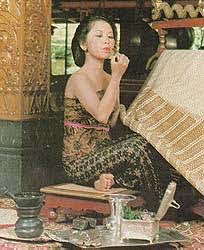
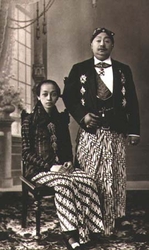
In Indonesia on the island of Java, in the not too distant past, sarongs of certain designs and patterns were strictly reserved for royalty and where the property of Kings, Queens, Nobles and Aristocrats. Imitating these designs and wearing them in public was punishable by death!!! Some of these designs can be found in our "Traditional Batik" at: Java Traditional


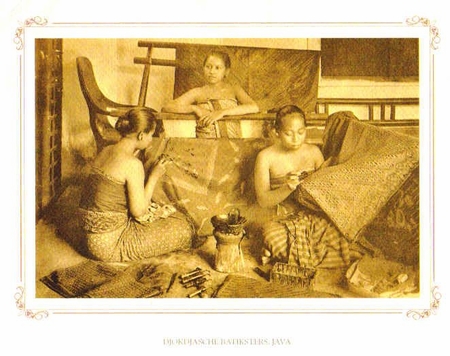
It takes many many hours of hard work to create a sarong. The process is very long and difficult. Sarongs are created using the art of Batik. Read more about it at: "Batik".

But the best part of it all is you'll fall in love with your sarong. The colors and patterns are amazing and you'll be hypnotized and swept away by the beauty! You'll never want to put it down or take it off. Plus you'll never find these in a big department store. Each is a work of art on its own and is hand made not mass produced.

Sarongs are gaining more and more popularity. Especially as our world becomes smaller and we begin to reach out and interact with new cultures. Meeting new people and experiencing different ways of living is very exciting. We discover wonderful gifts and treasures along the way.

Sarongs are one of these treasures we'd like to share with you.

If you would like more information or would like to make suggestions or comments please email us at info@1worldsarongs.com!

Thanks!!!
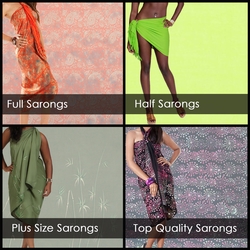


SARONGSSARONGS450+ Sarong Designs Starting at $7.99

WHAT IS BATIK?WHAT IS BATIK?What is Batik?

Simply, batik is an amazing and ancient method of color dyeing. Technically, batik is the process of applying dyes to porous surfaces. Historically, batik has been around for many hundreds of years. Esthetically, batik produces some of the most beautiful art in the world. However, batik is not easy and involves a very labor intensive and complex process with many hours of back breaking hard work.

The first step in Batik is to design a pattern and have an idea of what you would like to create. In Indonesia where many believe to be the cradle of batik, the pattern is either stenciled with a special tool called a "Tulis".

Wax is then placed in specific areas on the fabric using a "Canting" tool. Wax acts like a barrier to the color dyes and allows a color to remain while the remaining non-waxed fabric absorbs the dye. Some times called “Resist Dyeing”. Most of the time the wax is then removed by soaking the fabric in hot water. Occasionaly some wax will remain on the fabric and is easily removed in a warm wash cycle.

The batik process of dyeing and waxing repeats. The wax can be removed and re-applied several times to make beautiful and intricate designs. Repeating until all the desired colors and patterns are obtained.

The process of batik is practiced around the world. New methods and techniques are continually evolving. Indonesian batik artists are well known through out the world as the best batikers. From the beautiful islands of Bali and Java young Indonesians start in their villages learning from the elders.

We are happy to share with you batik from Indonesia and around the world. Let us know if you have any questions or comments at feedback@1worldsarongs.com.

Please click on the links for more information.

HOW TO TIE A SARONG (SARONG / PAREO TIES, USES, ETC...) HOW TO TIE A SARONG (SARONG / PAREO TIES, USES, ETC...) How do you tie a sarong?, is the most frequently asked question. Tying a sarong is not as complicated as it may seem. Tying your sarong just takes a little patience, practice, experimentation and a relaxed attitude. One of the easiest methods is to tie your sarong as a skirt around your waist. However, sarongs can be utilized to make quick dresses, shawls, swimsuit cover-ups, scarves, turbans and much more. To help you get a better understanding of how to wear your sarong, we've included some ideas on how to tie your sarong in this section. Check out the pictures and read the instructions and before you know it you'll be a sarong tying expert!

WARNING: Sarongs are extremely addictive and once you start wearing them you'll never want to take them off!

Did you know that sarongs are quickly becoming one of the most essential fashion accessories? Why is this you ask? Simply, sarongs are amazing. They travel well, look great and feel fantastic. In a nut shell, sarongs provide convenience and fashion too.

Sarongs are easy to wear and very sexy, no doubt about it. So learn to tie your sarong in the best way possible. You want to look great and you don't want it falling off of while your walking down the street. That could be embarrassing. A sarong tie is a good idea too. Sarong ties give you a little extra hold and security.

We've included a few ways of how to tie a sarong. Plus we also have a booklet on how to tie your sarongs, some pictures of how to tie sarongs and sarong ties as well.

Check out our pictures and links below to get more info on sarong ties and uses. Stay tuned because there's more on the way.

Click to enlargePicture of Javanese Royal Family (wearing sarong) (est. circa 1922)
Indonesian Sarongs and Textiles at the National Gallery of AustraliaIndonesian Sarongs and Textiles at the National Gallery of AustraliaCheck out this link to see the most complete collection online of Indonesian textiles we've seen:

http://www.nga.gov.au/SariToSarong/index.cfm

How to Care for a Sarong - 5 Easy Steps How to care for your sarongs is a question we hear quite often.

So, I asked Nancy J., who is one of our long time 1 World Sarongs customers (8 years) and has bought literally hundreds if not thousands of sarongs from us and therefore an expert in caring for sarongs. Nancy turns our sarongs into beautiful outfits. She's an independent seamstress / fashion designer who creates marvelous caftans / ponchos from our sarongs to sell to specialty boutiques in New Mexico.

Nancy called to place an order the other day(knowing we're getting our delivery and to get first dibs), as she does every few months, so I figured this was the perfect time to pick her brain and ask about how she cares for her sarongs.

So here's what she said:

  1. Unfold your sarong and shake it out a little
  2. Load into your washer machine (Nancy does up to eight sarongs at a time)
  3. Set your washer to cold water rinse - with medium water level - NO need for detergent
  4. When washer is finished take sarongs and shake out a little and separate them
  5. Load into dryer with a fabric softener - delicate setting - for 30 minutes
  6. After 30 minutes clean the lint filter and then run dryer for another 10 minutes
  7. Take sarongs out of dryer and spread them out on a bed or flat surface (Nancy folds them in half)
  8. Then run your hands over them to get any wrinkles out
Notes:

Make sure to take your sarongs out of the dryer right away so they don't wrinkle.

If you do decide to iron your sarongs make sure you set your iron on a very low setting.

Note, this is for the care of rayon sarongs and of course cotton or silk or poly should be handled differently. (We'll cover those at another time)

The advantage to washing this way is the dryer will set the colors of your sarongs so you don't have to worry about the colors running.

Wasn't that simple?

Ok, you got us...that was eight steps ;-) just checking to see if your paying attention :-P

This method applies to our lovely clothing too. So just use the same methods to care for your sundresses and other items from 1 World Sarongs.

Have an idea on how to care for your sarongs / clothing?

A different method?

A better way to do it?

Why not leave us your comments or suggestions?

Hope you're having a wonderful summer,

Terry


LOVE IS THE ANSWER


SARONGS | BEADS | JEWELRY | SCARVES | CLOTHES | INDONESIAN ART
What's a "Sarong"? | SALE | Search this Site
Current Order | MAILING LIST | Info | HOME |


EMAIL at:CustomerService@1WorldSarongs.com

PHONE: 888 727 6647

Bookmark our shop!


1 WORLD SARONGS® is a registered trademark of 1 WORLD SARONGS. All 1 WORLD SARONGS prints, designs, and proprietary material are copyrighted and owned by 1 WORLD SARONGS. Unauthorized reproduction is a violation of U.S. Federal law. © 2000-2009 1 World Sarongs, All Rights Reserved.